

It’s January 2026, and if you’re still carrying a proprietary “brick” charger for your laptop, you’re officially in the minority.
I remember just a few years ago when 65W was considered “fast” and 100W was the absolute ceiling for USB-C. Back then, if you had a high-performance gaming laptop or a workstation, you were tethered to a bulky, heat-spewing AC adapter with a proprietary barrel jack. But the landscape has shifted. Today, at GaNCharge, we are witnessing a fundamental pivot in the industry. The 140W–240W USB Power Delivery (PD) 3.1 revolution isn’t just a “nice-to-have” anymore; it’s the lifeline of the modern AI-driven workspace.
In this deep dive, I’m going to pull back the curtain on why this specific wattage range has become the gold standard, how Gallium Nitride (GaN) makes it possible, and what you—as a consumer or a B2B partner—need to know to stay ahead in 2026.
Table of Contents
The AI Laptop Hunger Games: Why Power Demand Skyrocketed
Let’s talk about the elephant in the room: AI. In 2025 and 2026, we saw the birth of the “AI PC” or “Copilot+ PC” era. These aren’t just faster laptops; they are machines equipped with dedicated NPUs (Neural Processing Units) designed to run Large Language Models (LLMs) and generative tools locally.
Why does this matter for your charger? Because local AI processing is power-hungry. When your laptop is generating a 4K video background in real-time or running a local instance of an AI assistant while you work, the sustained power draw on the GPU and NPU is significantly higher than a standard office workload.
I’ve seen tests where high-end AI workstations spike past 130W during heavy inference tasks. If you’re using an old 100W PD 3.0 charger, your laptop won’t just charge slowly—it might actually drain the battery while plugged in. This is why the 140W (28V) and 240W (48V) standards are now mandatory for anyone serious about performance.
Deep Dive: What Exactly is USB PD 3.1 (EPR)?
If you’re confused by the acronyms, you’re not alone. Let’s break it down. For a decade, USB-C was limited to 100W (20V at 5A). This was known as the Standard Power Range (SPR).
In 2021, the USB-IF introduced PD 3.1, which unveiled Extended Power Range (EPR). This breakthrough allowed USB-C to climb all the way to 240W.
The Three New Magic Numbers
EPR introduced three new fixed voltage levels that changed the game:
- 28V (Up to 140W): Targeted at flagship consumer laptops like the MacBook Pro 16.
- 36V (Up to 180W): The sweet spot for mid-range gaming laptops.
- 48V (Up to 240W): For extreme workstations, high-end GPUs, and even e-bikes.
But it’s not just about raw voltage. PD 3.1 also introduced Adjustable Voltage Supply (AVS). Unlike the old days where the charger only offered fixed steps (like 5V, 9V, 20V), AVS allows the laptop to request voltage in 100mV increments. This fine-tuned “handshake” between the device and the charger minimizes energy waste and heat—crucial when you’re pushing 140 watts through a connector the size of a fingernail.
Why GaN is the Only Reason Your Charger Doesn’t Melt
You might wonder: If we can do 240W now, why didn’t we do it ten years ago? The answer is Silicon. Traditional silicon-based chargers are inefficient at high wattages. To output 140W using silicon, the charger would need to be the size of a lunchbox to dissipate the heat.
This is where Gallium Nitride (GaN) technology—our specialty here at GaNCharge—comes in. GaN is a wide-bandgap semiconductor that outperforms silicon in three critical areas:
- Switching Speed: GaN can switch power 20x faster than silicon.
- Heat Management: It has a much lower resistance, meaning less energy is lost as heat.
- Size: Because it stays cool, we can pack the components much tighter.
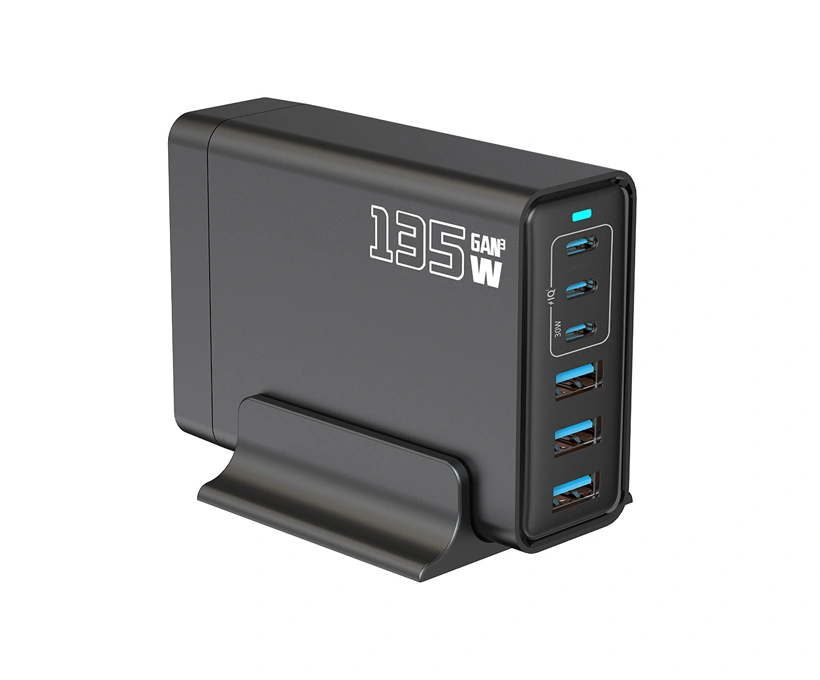
In 2026, we are using GaN V (Fifth Generation) chips. This allows us to build a 135W multi-port charger that is roughly the same size as an old Apple 61W silicon charger. For me, the most rewarding part of this tech is seeing a professional travel with one single 240W GaN block that powers their laptop, phone, and tablet simultaneously, replacing three pounds of “tech baggage.”
Comparative Analysis: PD 3.0 vs. PD 3.1
To help you visualize the “Information Gain” here, let’s look at how the standards actually compare in a real-world environment.
| Feature | USB PD 3.0 (SPR) | USB PD 3.1 (EPR) | 2026 Impact |
| Max Wattage | 100W | 240W | Essential for AI & Gaming |
| Max Voltage | 20V | 48V | Replaces proprietary barrel jacks |
| Voltage Control | Fixed Steps / PPS | AVS (Adjustable Voltage) | Lower heat, longer battery life |
| Safety Protocol | Basic Handshake | Strict EPR Handshake | Prevents arcing at high voltage |
| Cable Requirement | Standard 5A | E-Marked EPR (240W) | Mandatory for safety & speed |
| Typical Devices | Phones, Ultrabooks | AI Workstations, E-Mobility | One charger for everything |
The OEM Perspective: Why Your Brand Needs 140W+ Now
If you are an OEM or a brand owner looking to source from China, let me be blunt: The 100W market is becoming a commodity. Prices are bottoming out, and the competition is fierce.
The growth is in the 140W–240W segment.
- Future-Proofing: Every major laptop manufacturer has shifted to PD 3.1. Sourcing 140W chargers now ensures your product remains relevant for the next 3–5 years.
- Higher Margins: Consumers are willing to pay a premium for “one charger to rule them all.” A 3-port 140W GaN charger is currently the highest-ROI item in the mobile accessory category.
- The “Universal” Appeal: With the EU Common Charger Mandate fully in effect as of late 2024, proprietary chargers are effectively dead in Europe. Brands that offer high-wattage USB-C solutions are winning the transition.
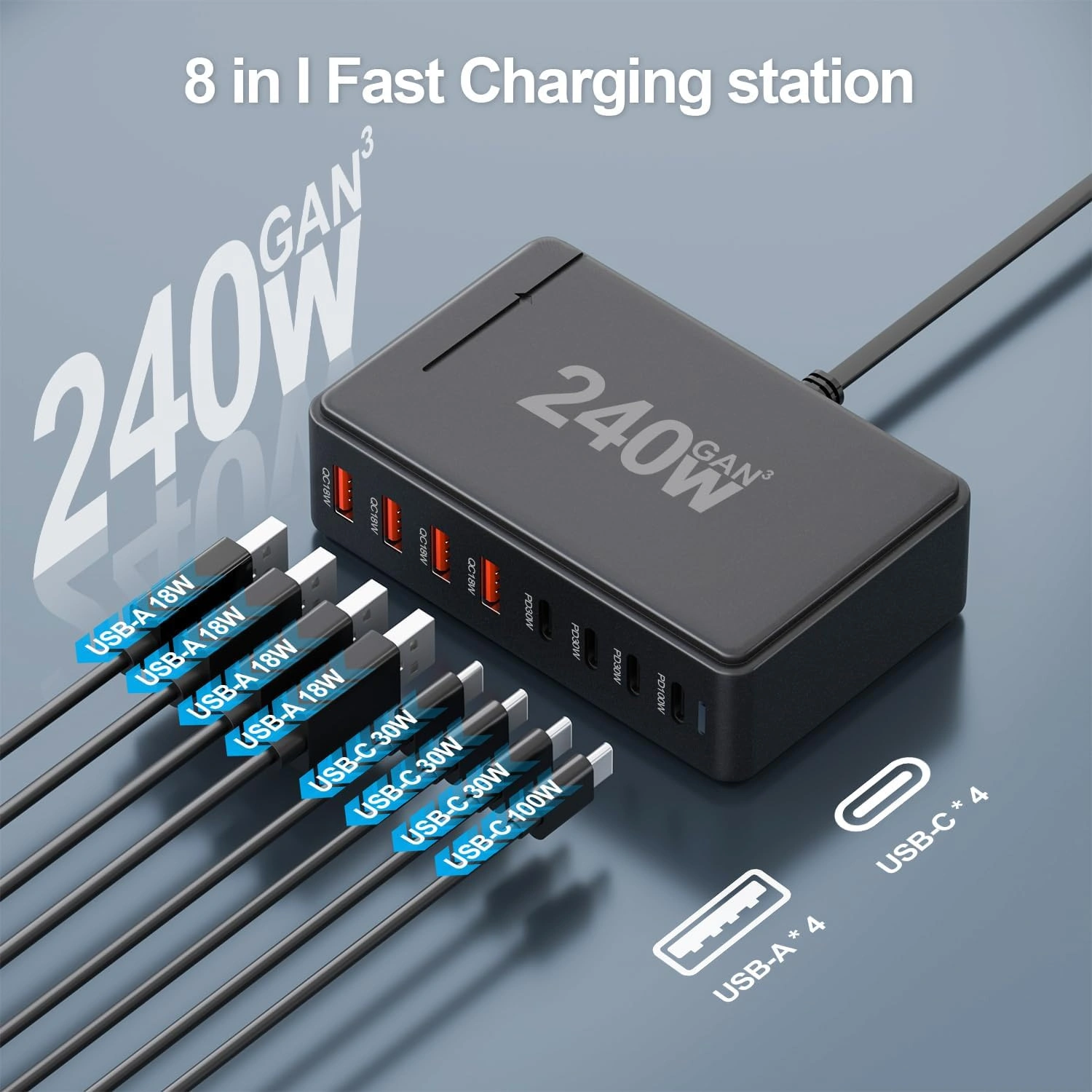
At our factory, we’ve optimized the production of the 140W 3-port (2C1A) configuration. It strikes the perfect balance between cost-efficiency and power density, making it our most requested OEM design for 2026.
Don’t Forget the Cable: The 240W “Gatekeeper”
I often see users buy a premium 140W GaN charger and then use a cheap cable they found in a drawer. This is a mistake.
To access wattages above 100W, you must use an E-Marked EPR Cable. These cables contain a tiny chip that tells the charger, “I am certified to handle 48V/5A safely.” Without this chip, the charger will safely throttle down to 60W or 100W to prevent the cable from overheating or catching fire. When sourcing for your brand, always bundle an EPR-certified cable to ensure the end-user actually gets the performance they paid for.
FAQ: Everything You Wanted to Ask About PD 3.1
Q1: Can I use a 240W charger for my iPhone?
A: Absolutely. One of the best features of PD 3.1 is backward compatibility. The charger and the phone will talk to each other, and the charger will only provide the ~27W-30W that the iPhone requests. It won’t “fry” your device.
Q2: Does 140W charging damage my laptop battery?
A: No, provided the device is designed for it. Most modern AI laptops use multi-cell batteries that distribute the incoming current. Furthermore, the Adjustable Voltage Supply (AVS) in PD 3.1 ensures the charging is highly efficient, reducing the heat that usually causes battery degradation.
Q3: Why are some 140W chargers so much cheaper than others?
A: It usually comes down to the GaN component quality and safety certifications. Cheap chargers often omit the necessary EMI shielding or use older GaN generations that run hotter. Always look for UL, CE, or FCC markings.
Q4: Will 240W become the final limit for USB-C?
A: For now, yes. 240W is the maximum defined by the USB-IF. To go higher, the physical pins of the USB-C connector would likely need a redesign to handle the arcing risks associated with higher voltages.
Conclusion: Moving Toward a Proprietary-Free Future
The “Power Revolution” isn’t just about faster charging; it’s about freedom.
I’ve spent years in the manufacturing trenches, and seeing the industry finally align on a single, powerful, open standard like PD 3.1 is incredibly exciting. Whether you are a digital nomad needing to power a 16-inch workstation in a cafe, or a brand manager looking to launch the next “must-have” tech accessory, the 140W–240W range is where the future lives.
At GaNCharge, we aren’t just making chargers; we’re enabling the next generation of AI-powered productivity. Are you ready to cut the cord on your old power bricks?
References & Further Reading
- USB-IF Official Specifications
- GaN Systems (Infineon): How Gallium Nitride is Changing Power Electronics
- The Verge: The EU’s Common Charger Policy and What it Means for You
- ChargerLAB: In-depth Teardowns of 140W and 240W GaN Chargers