

From 100W 5-port hubs to 240W 8-port powerhouses — GaNCharge designs and manufactures multi-port GaN chargers and desktop charging stations for global brands, distributors, and commercial deployments. CE/FCC/RoHS certified. Full OEM/ODM service. Low MOQ.
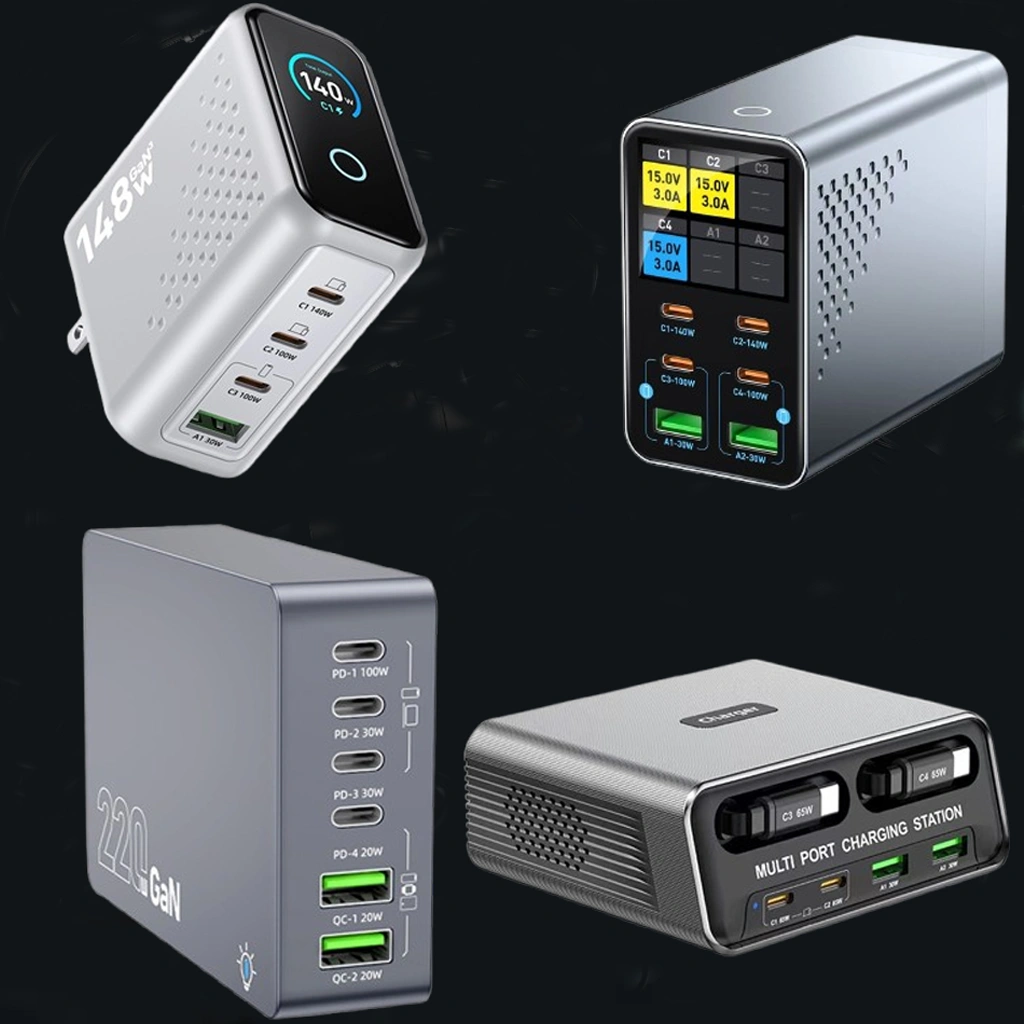
What Is a Multi-Port High-Wattage GaN Charger?
A multi-port high-wattage GaN charger is a desktop power hub that delivers high total output — typically 100W to 240W — across four to eight USB ports simultaneously, using Gallium Nitride (GaN) semiconductor technology instead of traditional silicon transistors.
The distinction from ordinary multi-port chargers is meaningful. A standard USB-A charging hub might deliver 5V/2.4A per port — barely enough for a slow phone charge. A multi-port high-wattage GaN charger delivers USB Power Delivery (PD) at 65W, 100W, or 140W per port, enough to fast-charge a MacBook Pro, a gaming laptop, or two devices at once from a single hub.
GaN technology is what makes this possible in a compact form factor. A silicon charger delivering 200W across six ports would require a large, heavy power brick with significant heatsinking. A GaN-based equivalent is typically 40–50% smaller and 30% lighter — desk-friendly, portable, and retail-competitive.
Why this category is growing rapidly
The global multi-port USB charger market is projected to exceed $4.5 billion by 2027. Three forces drive this: universal USB-C adoption (EU mandated for phones from 2024; laptops from 2026), the proliferation of AI laptops requiring 100W+ charging, and the “one charger for everything” consumer preference that GaN power density uniquely enables.
Why GaN Makes High-Wattage Multi-Port Possible
Traditional silicon power transistors have a fundamental physical limitation: they generate significant heat during high-frequency switching, requiring large passive components (transformers, capacitors, heatsinks) to manage that heat. At 100W+, a silicon-based multi-port charger becomes impractically large and runs hot enough to require active cooling or conservative thermal derating.
GaN transistors switch at 10–20× higher frequencies than silicon with dramatically lower switching losses. This produces two direct product benefits:
- Smaller passive components. Higher switching frequency means smaller transformers and capacitors can store and deliver the same energy. A 140W GaN charger can occupy the same desk footprint as a 65W silicon charger.
- Lower heat output. Less energy is wasted as heat. GaN chargers run cooler, enabling higher sustained power without thermal throttling — critical when all ports are in use simultaneously.
GaN³ — The Third Generation
GaNCharge’s 100W desktop stations (WLX60C and WLX60D) use GaN³ (third-generation GaN) transistor technology. Compared to first- and second-generation GaN ICs, GaN³ devices achieve lower on-resistance (RDS(on)), meaning even less heat is generated per watt delivered. In practice, the surface temperature of a GaN³ 100W charger under full load is measurably lower than an equivalent first-gen GaN design — a tangible benefit in commercial deployments where chargers run continuously for hours.
Choosing the Right Wattage: 100W vs 140W vs 200W+
The total wattage of a multi-port GaN charger determines which device combinations it can power simultaneously at full speed. Here is how the tiers break down in practical terms:
HOME & OFFICE DESK
100W
POWER USER / MEETING ROOM
120–
140W
MULTI-LAPTOP / STUDIO
200–
220W
MAXIMUM DENSITY
240W+
The 140W threshold for AI laptops
MacBook Pro 16″ (M3 Pro/Max), ASUS ProArt Studiobook, Lenovo ThinkPad X1 Extreme Gen 6, and most AI workstation laptops released from 2025 onward require USB PD 3.1 at 140W (28V/5A) for full-speed charging. Chargers capped at 100W PD 3.0 will charge these laptops, but at reduced speed — the laptop will draw from the battery under heavy AI/GPU load while charging. If your target audience uses professional laptops released 2024 onward, specify PD 3.1 140W as a minimum requirement.
Protocol Guide: USB PD 3.1, QC 4.0, PPS, SCP, AFC
Multi-port GaN chargers must support a matrix of fast-charging protocols to be universally compatible. Here is what each protocol means and which devices it serves:
| Protocol | Max Power | Voltage Range | Compatible Devices | Port Type |
|---|---|---|---|---|
| USB PD 3.1 EPR | 240W (28V/5A typical) | 5V – 48V | MacBook Pro 16″, high-end Windows laptops, AI workstation laptops 2024+ | USB-C only |
| USB PD 3.0 | 100W (20V/5A) | 5V – 20V | MacBook Air/Pro, iPad Pro, most USB-C laptops, iPhone 12+, Samsung | USB-C only |
| PPS (Programmable Power Supply) | 45W typical | 3.3V – 21V (variable) | Samsung Galaxy (Super Fast Charging 2.0), Xiaomi, OPPO, Pixel 6+ | USB-C only |
| QC 4.0 / 4+ | 28W | 5V – 20V | Qualcomm Snapdragon flagship phones, compatible laptops | USB-C USB-A |
| QC 3.0 | 18W | 3.6V – 20V (INOV) | Android phones with Snapdragon 820+, most mid-range Android devices | USB-A primarily |
| Huawei FCP / SCP | 40W (SCP) | 5V / 9V / 10V | Huawei / Honor smartphones and tablets | USB-C USB-A |
| Samsung AFC | 25W | 5V / 9V / 12V | Samsung Galaxy S/A series, Samsung tablets | USB-C USB-A |
| Apple Fast Charge | 20W (iPhone) / 30W (iPad) | 9V/2.2A | iPhone 8+, iPad Air/Pro with USB-C | USB-C |
| BC 1.2 | 7.5W (1.5A@5V) | 5V | Legacy USB-A devices, accessories, earbuds, wearables | USB-A primarily |
Which protocols does your target market need?
For North American / European consumer electronics brands: USB PD 3.0/3.1 + QC 3.0 covers 95%+ of devices.
For Chinese domestic or Southeast Asian markets: add Huawei SCP/FCP and Samsung AFC.
For enterprise / commercial deployments: prioritise USB PD 3.1 for laptop compatibility and BC 1.2 backward compatibility for legacy accessories.
Smart Power Distribution — How It Actually Works
Smart power distribution (also called intelligent power allocation or dynamic power management) is the microcontroller logic that determines how a fixed total wattage is divided among connected ports in real time. It is one of the most misunderstood specifications in multi-port charger buying decisions.
The core principle: the total output power of the charger cannot exceed its rated maximum. When multiple devices are connected, the charger’s MCU (microcontroller unit) reads the power demand of each device using the PD or QC communication protocol, then assigns each port an output voltage and current that maximises the charge rate for each device without exceeding the total budget.
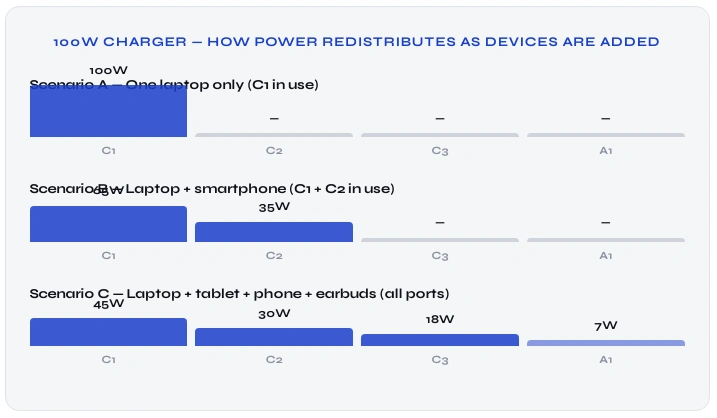
The practical implication for OEM buyers: always specify the per-port output when multiple ports are active, not just the single-port maximum. A charger advertised as “65W per port” may only deliver 20W per port when all six are in use. GaNCharge provides full power allocation matrices in product datasheets so buyers can make accurate assessments for their target use case.
New in 2025–2026: HD Displays, Rotary Knobs & RGB Lighting
The multi-port GaN charger market has moved well beyond plain black boxes with LEDs. Three differentiating features are now actively requested by OEM buyers seeking premium retail positioning:
HD Colour Power Displays
GaNCharge’s WLX-G3 (140W, 6-port) features a front-facing HD colour display showing live voltage (V) and current (A) per port in a six-panel grid. Active high-power ports display in yellow; standard power ports in blue; idle ports show dashes. A single touch of the top button switches to a ring view showing total combined output wattage. For premium retail SKUs, this feature provides visible proof of performance — customers can see exactly what the charger is delivering at any moment.
HD Smart Display + Rotary Knob
The WLX60D (100W, 5-port) pairs a 2.3-inch HD real-time power display with a rotary control knob — a UI pattern borrowed from professional audio equipment. The knob controls display brightness and cycles between power data views. For brands targeting a premium home-office or gaming-desk positioning, the physical knob adds a tactile quality that distinguishes the product in a photograph and on the shelf.
RGB Lighting
The 6×100W 8-port desktop station integrates RGB accent lighting around its base — a deliberate feature for gaming-desk and streamer-station positioning. RGB can be customised in colour and pattern for OEM brand identity. This model targets the gaming peripheral and streaming accessories market segment where aesthetic differentiation drives purchasing decisions.
GaNCharge Multi-Port GaN Charger Product Line
All models below support OEM branding, custom packaging, and multi-region plug configurations. Click any product to view full specifications and request a quote.
SKU: WLX60D
100W GaN³ Desktop Station — 5-Port with HD Display & Rotary Knob
SKU: WLX60C
100W GaN³ Chargers — 6-Port with Dual Retractable USB-C Cables
SKU: WLXG3
140W PD 3.1 GaN Station — 6-Port with HD Colour Display
SKU: WLXF8A
220W GaN 6-Port Charger — 4× USB-C PD + 2× USB-A
Who Buys Multi-Port High-Wattage GaN Chargers
Multi-port GaN desktop chargers serve four primary buyer verticals, each with distinct port count, wattage, and certification requirements:
Premium charging accessory, laptop bundle, or Amazon private label. Shoppers compare spec sheets — HD displays and per-port wattage are key purchase drivers.
Recommended: WLXG3 140W or 220W F8A — strong retail spec story
Desk aesthetics matter as much as performance. RGB lighting, bold product language, and multiple simultaneous 100W+ ports for laptop + monitor + controller + phone.
Recommended: 6×100W RGB station or 240W 8-port
Hot-desk charging, meeting room power hubs, employee device programmes. Specification-driven procurement — certifications, safety protections, and durability are non-negotiable.
Recommended: 120W 8-port (mixed C+A fleet) or 140W WLXG3
Bundled with router, modem, or 5G CPE. High-volume, cost-sensitive, strict brand compliance. Needs multi-region plug and full white-label capability.
Recommended: 100W WLX60D or 120W 8-port with OEM packaging
OEM/ODM Customisation Options
Every multi-port GaN charger in the GaNCharge line is available for full OEM customisation. The table below summarises what can be modified at different project scales:
| Feature | Standard OEM | ODM (Custom Design) |
|---|---|---|
| Brand logo | Laser engraving or printing | Tooled into housing design |
| Housing colour / finish | Selection from standard palette | Custom colour, texture, material |
| Port configuration | As per model | Custom C/A mix, count, positioning |
| Total wattage | Fixed per model | Engineered to specification |
| Display type | As per model (none / digital / HD) | Custom display content and UI |
| Plug type | US / UK / EU / AU (select) | Any regional standard |
| Cable length (AC) | Standard 1.2m or 1.5m | Custom length |
| Retail packaging | White-label or custom box print | Full retail shelf packaging design |
| Certifications | CE / FCC / RoHS (standard) | Additional: UL, PSE, KC, BIS on request |
| Firmware | Standard power allocation logic | Custom allocation curves, OEM-specific behaviour |
Low MOQ — start small, scale fast
GaNCharge supports low minimum order quantities across all multi-port GaN charger models. This enables new brands to launch a product, test market response, and gather customer feedback before committing to large production runs. Contact us with your target wattage, port configuration, and volume estimate for a personalised MOQ and unit pricing.

Frequently Asked Questions
What is a multi-port high-wattage GaN charger?
A multi-port high-wattage GaN charger is a desktop power hub using Gallium Nitride (GaN) semiconductor technology that delivers 100W to 240W+ total output across four to eight USB ports simultaneously. GaN technology enables this power density in a 40–50% smaller form factor than an equivalent silicon charger. These chargers support USB PD 3.0/3.1, QC 4.0, PPS, and other fast-charge protocols to be universally compatible with laptops, tablets, and phones from all major brands.
What is the difference between USB PD 3.0 and USB PD 3.1?
USB PD 3.0 supports a maximum of 100W (20V/5A). USB PD 3.1 introduces Extended Power Range (EPR), enabling up to 240W by supporting voltages of 28V, 36V, and 48V. The most commercially relevant threshold is 140W (28V/5A), required by MacBook Pro 16-inch and AI workstation laptops from 2025 onward. GaNCharge’s WLX-G3 delivers true PD 3.1 at 140W on two ports simultaneously — the only way to fast-charge these laptops at their rated speed.
Can a multi-port GaN charger power two laptops at the same time?
Yes — provided the total wattage and per-port allocation support it. The WLXG3 (140W PD 3.1) delivers 140W on both C1 and C2 simultaneously. The 6×100W 8-port station delivers independent 100W to each of six USB-C ports. The 220W 6-port (F8A) provides 100W on C1 and C2 at the same time. The key specification is the per-port output when multiple ports are active — always request the full power allocation matrix from your supplier.
What does GaN³ mean in a charger?
GaN³ refers to the third generation of Gallium Nitride power transistor technology. Compared to first- and second-generation GaN, GaN³ transistors achieve lower on-resistance (RDS(on)) and faster switching, resulting in less heat generated per watt delivered. In practice, a GaN³ 100W charger runs measurably cooler than an equivalent first-gen GaN design. GaNCharge’s WLX60C and WLX60D use GaN³ technology.
How does smart power distribution work?
Smart power distribution uses a microcontroller to read each connected device’s power demand via the PD or QC communication protocol, then dynamically assigns each port a voltage and current that maximises charge speed without exceeding the charger’s rated total wattage. When a high-power device is connected alone, it receives the full budget. As more devices are added, the MCU rebalances automatically in real time. Always check the per-port allocation at full-load (all ports active), not just the single-port maximum.
What certifications do GaNCharge multi-port chargers carry?
All GaNCharge multi-port high-wattage GaN chargers are CE (EU), FCC Part 15 (US), and RoHS certified as standard. UL listing is available for North American market SKUs. All models support 100–240V input for global compatibility. Additional certifications including PSE (Japan), KC (South Korea), and BIS (India) are available for ODM projects targeting those markets.
What OEM customisation is available?
GaNCharge supports full OEM and ODM customisation: logo laser engraving or printing, housing colour and finish variants, port count and configuration, custom total wattage (ODM), display type selection, plug type (US/UK/EU/AU), AC cable length, retail packaging design, multi-language instruction manuals, and additional market certifications. ODM projects can involve entirely custom housing tooling. Low MOQ is supported to enable brand trials before scaling.
Which model should I choose for a home office desk?
For a home office with one laptop and two to three additional devices (phone, tablet, earbuds), the 100W WLX60D (5-port with HD display) is the most versatile choice — 100W on port C1 for the laptop, 45W on ports C2–C4 for other devices. If you prefer a cable-free desk and your laptop charges at 65W or less, the 100W WLX60C with dual retractable cables offers a cleaner setup. For MacBook Pro 16″ or AI workstation laptops requiring 140W, the WLXG3 is the correct choice.
Related Content
- Retractable Cable GaN Chargers — Product Category & Overview
- GaN Charger OEM Manufacturer — Full Capabilities & Process
- Why 140W+ PD 3.1 Is the New Standard for AI Laptops in 2026
- Top 5 Multi-Port USB PD & QC Charger OEM Manufacturers in China
- Retractable Cable GaN Charger: Design, Materials & Magnetic Mechanism Explained
- Browse All Multi-Port High-Wattage GaN Chargers
Ready to Launch Your Multi-Port GaN Charger Brand?
Tell us your target wattage, port count, and market — we’ll respond within one business day with a preliminary specification and factory-direct quotation.