
If you have ever pulled a USB-C connector out of a compact charger body, felt a satisfying click as the magnet held it in place, and then watched the cable spool smoothly back inside, you have experienced one of the most underengineered product categories suddenly done right.
Retractable cable GaN chargers look deceptively simple from the outside. Underneath, they represent a convergence of four engineering domains that rarely talk to each other: power electronics (GaN switching circuits), mechanical design (spring-and-spool retraction), materials science (cable jacket selection), and magnetic engineering (connector retention). Getting any one of these wrong means a product that either fails electrically, seizes mechanically, cracks under cold conditions, or drops its connector at the worst possible moment.
At GaNCharge, we manufacture retractable cable chargers at scale — including the 30W mini travel charger with magnetic retraction and the 160W dual-cable desktop station. This article documents what we have learned across thousands of design iterations, supplier negotiations, and cycle-life tests. It is written for buyers, OEM brand managers, and engineers who need to understand what separates a good retractable charger from one that fails in the field.
Who this is for
Whether you are evaluating retractable chargers for a private-label brand, sourcing for a hospitality or office deployment, or simply want to understand what you are actually buying — this guide explains the engineering honestly, from a manufacturer who builds these products.
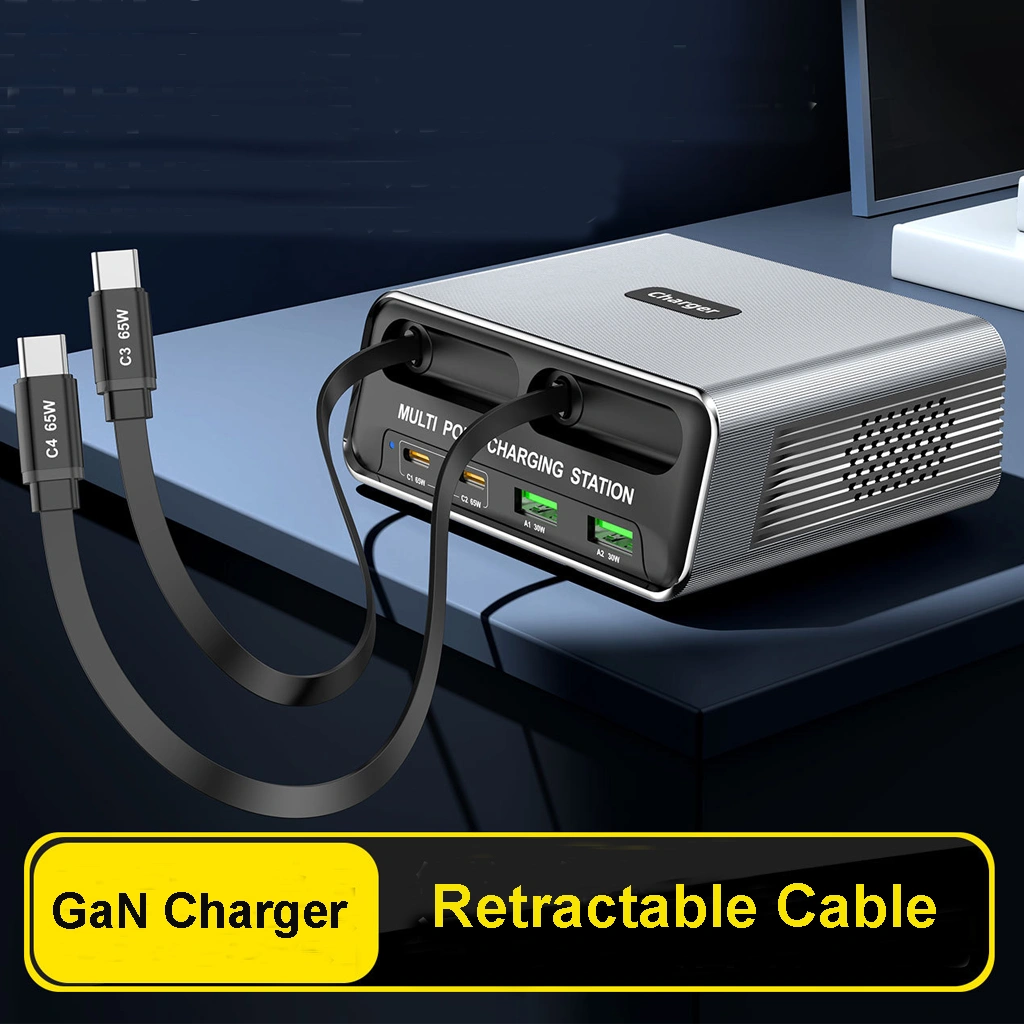
Table of Contents
Why Retractable Cables Are Having a Moment
The timing is not coincidental. Three market forces converged around 2023–2025 to create genuine demand for integrated-cable chargers:
1. The USB-C consolidation. With the EU mandate and Apple’s iPhone 15 switch to USB-C, nearly every device consumers carry now uses the same connector. That makes it viable to build a charger with a permanently integrated cable without worrying about multi-head compatibility — a constraint that would have plagued a Lightning + Micro-USB + USB-C world.
2. The forgotten cable problem. In a 2024 survey of business travellers, “forgot my charging cable” ranked as the number-one travel accessory frustration — ahead of adaptor incompatibility and battery capacity. A charger that is the cable eliminates this failure mode entirely.
3. GaN miniaturisation enabling new form factors. Traditional silicon chargers at 45W–65W required large housings that made integrating a spool mechanically impractical. GaN circuits delivering equivalent power at 40–50% smaller volume now leave enough internal space for a properly engineered retraction mechanism — without turning the product into an unwieldy brick.
Typical max cable extension
Retraction cycles — GaNCharge standard
Cycles — premium spec (TÜV-certified TPE)
Magnetic retention force at rest
How the Retraction Mechanism Works
There are two principal retraction architectures in the market today. Understanding the difference matters enormously for durability, feel, and maintenance.
Architecture A: Spring-Loaded Coil Spool
This is the dominant design for cables up to 100cm. A flat spiral spring (similar in principle to a measuring tape) is coiled around a central axle inside the housing. The USB-C cable is wound over the same spool. Pulling the cable stretches the spring. Releasing it causes the spring to retract the cable back onto the spool.
The key variables are: spring constant (too stiff = user fights to pull the cable; too loose = slow, incomplete retraction), spool diameter (smaller diameter means tighter bending radius on the cable — more stress per retraction), and cable routing geometry (the exit point from the spool must have a smooth radius to prevent kinking).
Most failures in this architecture occur not in the spring itself, but at the cable exit point where repeated micro-bending eventually fatigues the cable jacket and inner conductors.
Architecture B: Push-Button or Stepped-Lock with Magnetic Storage
Some designs use a ratchet-and-release mechanism where the cable locks at a preset extension length and releases with a button or second pull. These offer more precise length control but add mechanical complexity and failure points. They are more common in high-end desktop stations than in compact travel chargers.
Spring-Spool Retraction: How Each State Works
Connector tip held flush by embedded magnet. Spring at rest. Cable fully wound on spool.
User overcomes magnet force (~0.5 N). Spring stretches. Cable unspools smoothly.
Cable extended to required length. Spring maintains gentle retraction tension (cable stays taut).
Gentle tug toward charger releases cable from friction hold. Spring reels it in.
Magnet at connector tip aligns with housing magnet. Snaps flush. Cable parked cleanly.
The Magnetic Connector System — Engineering the “Click”
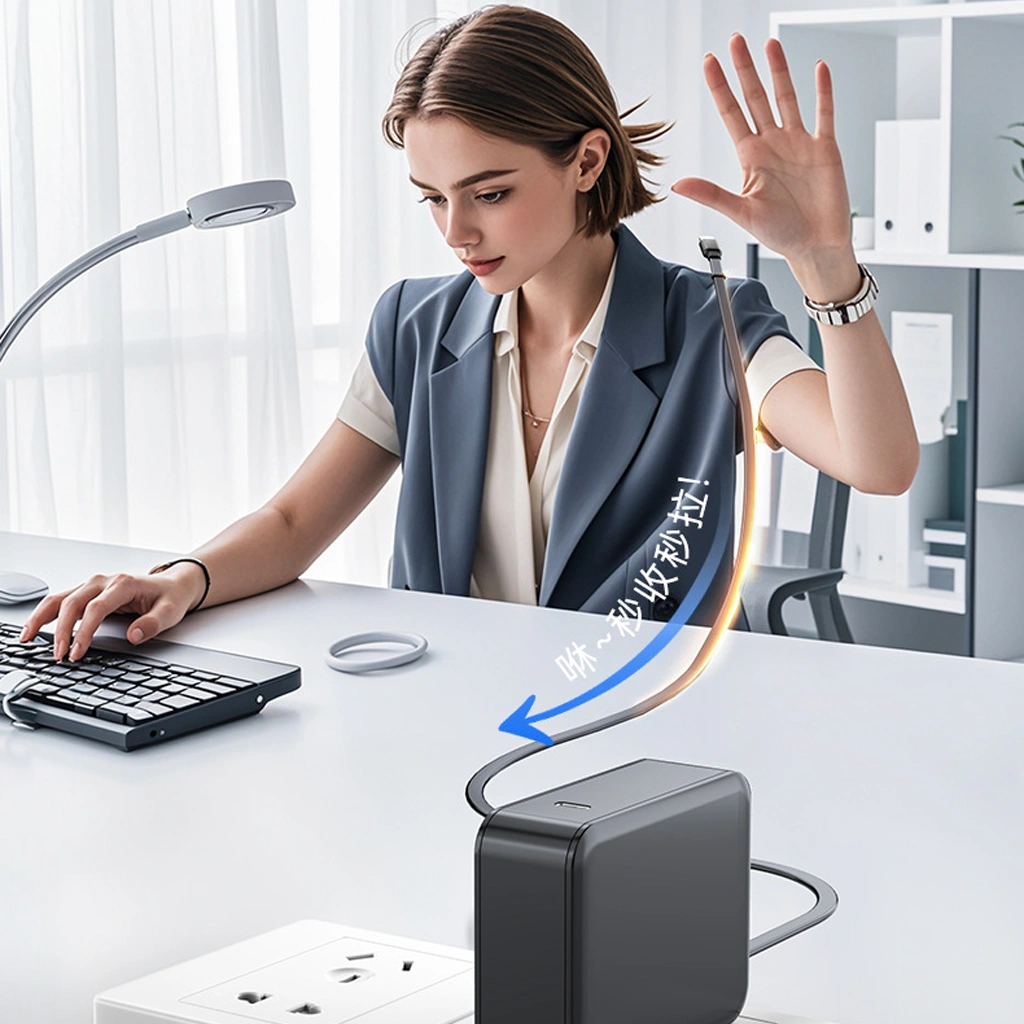
The magnet at the tip of the USB-C connector is one of those features that users experience as pure convenience, but that requires precise engineering to get right. Too weak, and the connector rattles loose in a bag. Too strong and users need to yank it out, creating excessive stress on the spool mechanism at the moment of highest cable tension.
Magnet Grades Used in Production
The charger market has converged on two neodymium (NdFeB) magnet grades for connector retention:
- N35 / N38: Lower energy product. Retention force approximately 0.3–0.4 N at the connector face. Used in lightweight travel chargers where the cable is thin and spool retraction force is modest.
- N52H: High-energy, high-temperature rated. Retention force approximately 0.6–0.8 N. Used in heavier desktop cables where the cable weight itself would otherwise cause the connector to slip out during use. Baseus adopted N52H magnets in their 2025 67W retractable GaN charger specifically for this reason.
The “H” suffix on the grade denotes a higher Curie temperature rating — critical because the connector sits adjacent to the GaN circuit during charging. Standard N52 magnets begin losing magnetic strength above 80°C. GaN chargers regularly reach 65–75°C at the connector zone under sustained load. An N52H magnet is rated to 120°C, preventing gradual demagnetisation over the product lifetime.
Connector Housing Integration
The magnet is typically overmoulded into the USB-C connector housing in a small cylindrical or disc geometry (3–5mm diameter, 1.5–2mm thickness). The matching retention point inside the charger body is either a second magnet (for higher force) or a soft ferromagnetic steel disc (cheaper, acceptable for lower-weight cables).
GaNCharge Engineering Team
Shenzhen, China — Retractable Charger Product Line
“One issue we encountered early in development: the magnetic flux from the connector-tip magnet can interact with the cable’s data conductors during USB 3.x or USB4 signal transmission, causing EMI. We now specify a magnetic shielding layer — a thin mu-metal foil — wrapped around the data conductor pairs within 10mm of the magnet. It adds less than 0.3g and eliminates the interference entirely. Most commodity designs skip this step, which is why you occasionally see retractable cables that charge fine but cause data transfer errors.”
Cable Material Selection: Why We Use TPE-E (And Why Nylon Braid Is Wrong Here)
This is the engineering decision that most end-users never think about and that most procurement teams get wrong. The retractable charger’s cable material must meet a requirement profile that is fundamentally different from a standard charging cable, and the dominant “premium cable” material (nylon braid) is actually a poor choice for retractable applications.
Here is the core constraint: a retractable cable is coiled around a spool with a diameter of typically 20–35mm, and this coiling-uncoiling cycle happens hundreds of times per day in commercial deployments. The material must:
- Have low surface friction against itself and the spool housing (to avoid binding)
- Have zero material memory (no permanent deformation from being coiled)
- Maintain flexibility at temperatures from -20°C to +75°C
- Survive 10,000+ coiling cycles without cracking, splitting, or conductor fatigue
- Maintain electrical insulation integrity after all of the above
- Cracks below 0°C
- Develops permanent memory when coiled
- High friction — causes spool binding
- Contains plasticisers that migrate over time, making surface sticky
- Not RoHS-friendly in standard formulations
- Better cold-temperature performance than PVC
- Recyclable (RoHS compliant)
- Still develops some memory under sustained coiling
- Surface can become tacky at elevated temperatures
- Typical cycle life: 5,000–8,000 retractions
- High elastic recovery — no permanent memory
- Low surface friction — smooth spool operation
- Stable from -30°C to +80°C
- RoHS and REACH compliant
- Cycle life: 10,000–30,000+ retractions
- Used in GaNCharge and Baseus retractable lines
- High surface friction — binds on spool
- Braid fibres catch on spool housing edges
- Braid frays at the cable exit point
- Excellent for standard cables — wrong application here
- Used in some budget retractable designs (poor longevity)
A note on “TÜV-certified eco-TPE”
Some 2025–2026 retractable chargers (notably from Baseus) now specify a TÜV-certified, ultra-flexible eco-TPE jacket. TÜV Rheinland’s certification covers both mechanical durability (30,000+ stretch cycles and 11,000 swing tests) and material safety. For OEM buyers, requesting TÜV-certified cable material is one of the cleaner ways to specify quality without getting into proprietary compound specifications.
Internal Conductor Design
The cable jacket gets the attention, but the conductor design inside is equally critical for retractable applications. Standard USB-C cables use relatively few thick copper strands per conductor. Retractable cables should specify fine-strand construction — more, thinner strands per conductor (e.g., 40-strand AWG28 instead of 7-strand AWG28). Fine-strand conductors have dramatically better fatigue resistance in bending applications because the mechanical stress is distributed across more individual wires, each of which undergoes a lower strain per cycle.
At GaNCharge, we specify a minimum of 30 strands per power conductor in our retractable cable assemblies, which is approximately 3–4× the strand count of a typical fixed cable at the same AWG rating.
Thermal Management: Harder Than It Looks
Integrating a retraction spool into a GaN charger body creates a thermal challenge that purely electronic chargers do not face: the spool occupies volume that would otherwise be available for heat-spreading components.
In a conventional GaN charger body, engineers can place thermal vias, copper planes, and aluminium spreaders wherever the PCB topology requires. In a retractable charger, a cylindrical volume — the spool — must be accommodated, and it typically sits in the thermal path between the GaN switching transistor and the outer housing.
Spool Thermally Isolating the GaN Stage
The spool assembly is plastic — a thermal insulator. This means heat generated by the GaN stage cannot conduct through the spool toward the outer housing faces adjacent to the spool. Engineers must route heat around the spool via the PCB’s copper layers to reach housing surfaces that have adequate thermal coupling to ambient air.
This is why the thermal pad placement in a retractable charger is more complex than in a fixed-cable design, and why early retractable charger products frequently ran hot. Adequate thermal management in a retractable GaN charger at 65W+ requires:
- Thermal interface material (TIM) between GaN device and PCB copper spreader
- Copper plane routing that routes heat to housing surfaces away from the spool zone
- Ventilation slots in the housing at the GaN stage location (where there is no spool blocking airflow)
- Derating the power at high ambient temperatures (automatic via the over-temperature protection system)
At what temperature is “too hot”?
IEC 62368-1 (the safety standard covering audio/video and IT equipment including chargers) requires that accessible surface temperatures on handheld equipment stay below 48°C for metal surfaces and 60°C for non-metal surfaces under normal operating conditions. A charger that burns your hand is failing this standard. GaNCharge retractable models are validated to maintain housing surface temperatures below 52°C at rated load in a 25°C ambient environment.
Durability & Cycle-Life Testing: What the Numbers Mean
Cycle-life numbers on retractable charger spec sheets need some interpretation before you use them to compare products.
What a “Retraction Cycle” Test Actually Measures
A standard retraction cycle test extends the cable to its maximum rated length, then retracts it fully, then pauses briefly. This is done under controlled conditions: room temperature (23°C ± 2°C), constant extension force, cable withdrawn at the rated angle. It does not simulate the following real-world factors:
- Off-axis pulls (pulling at 30–45° rather than straight out)
- Temperature cycling (-10°C to +60°C over the test)
- Simultaneous electrical load through the cable during retraction
- Contaminant exposure (skin oils, coffee, dust)
This means a “10,000-cycle” test under standard conditions is not the same as 10,000 cycles of field use. GaNCharge’s internal test protocol additionally requires:
- 500 cycles at -10°C (cold morning travel scenario)
- 500 cycles at +55°C (charging in a hot car or direct sun)
- 200 off-axis pull cycles at ±45°
- Electrical continuity verification (< 1Ω conductor resistance change) after the full cycle sequence
| Cycle Rating | Daily Use Equivalent* | Typical Product Tier | Cable Material |
|---|---|---|---|
| 3,000–5,000 cycles | 2–4 years (casual user) | Budget / entry-level retail | Standard TPE or PVC |
| 10,000 cycles | 9+ years (casual) / 3–4 years (office) | Mid-range / GaNCharge standard | TPE-E / high-elasticity TPE |
| 25,000 cycles | 20+ years (casual) / ~8 years (office) | Premium (UGREEN Nexode) | Advanced TPE compound |
| 30,000 cycles | ~10 years (office daily use) | Premium + TÜV certified | TÜV eco-TPE (Baseus 2025) |
*Based on 3 retractions/day casual use, 8 retractions/day office/commercial use.
The Connector Joint: Where Cables Actually Fail
Independent testing consistently shows that retractable cables rarely fail mid-cable. The failure point is almost always the junction between the flexible cable and the rigid connector housing — the point of maximum bending stress when the cable exits the spool at an angle or is pulled laterally.
Quality mitigation for this requires a strain relief moulding that extends at least 12mm from the connector housing, with a graduated hardness transition (from the rigid connector body to the flexible cable). Some manufacturers additionally use a Kevlar fibre core within the connector-end 50mm of the cable to absorb tensile loads before they reach the copper conductors.
GaNCharge Retractable Charger Line: Two Product Philosophies
Our current retractable cable GaN charger line reflects two distinct design philosophies, targeting different buyer needs.
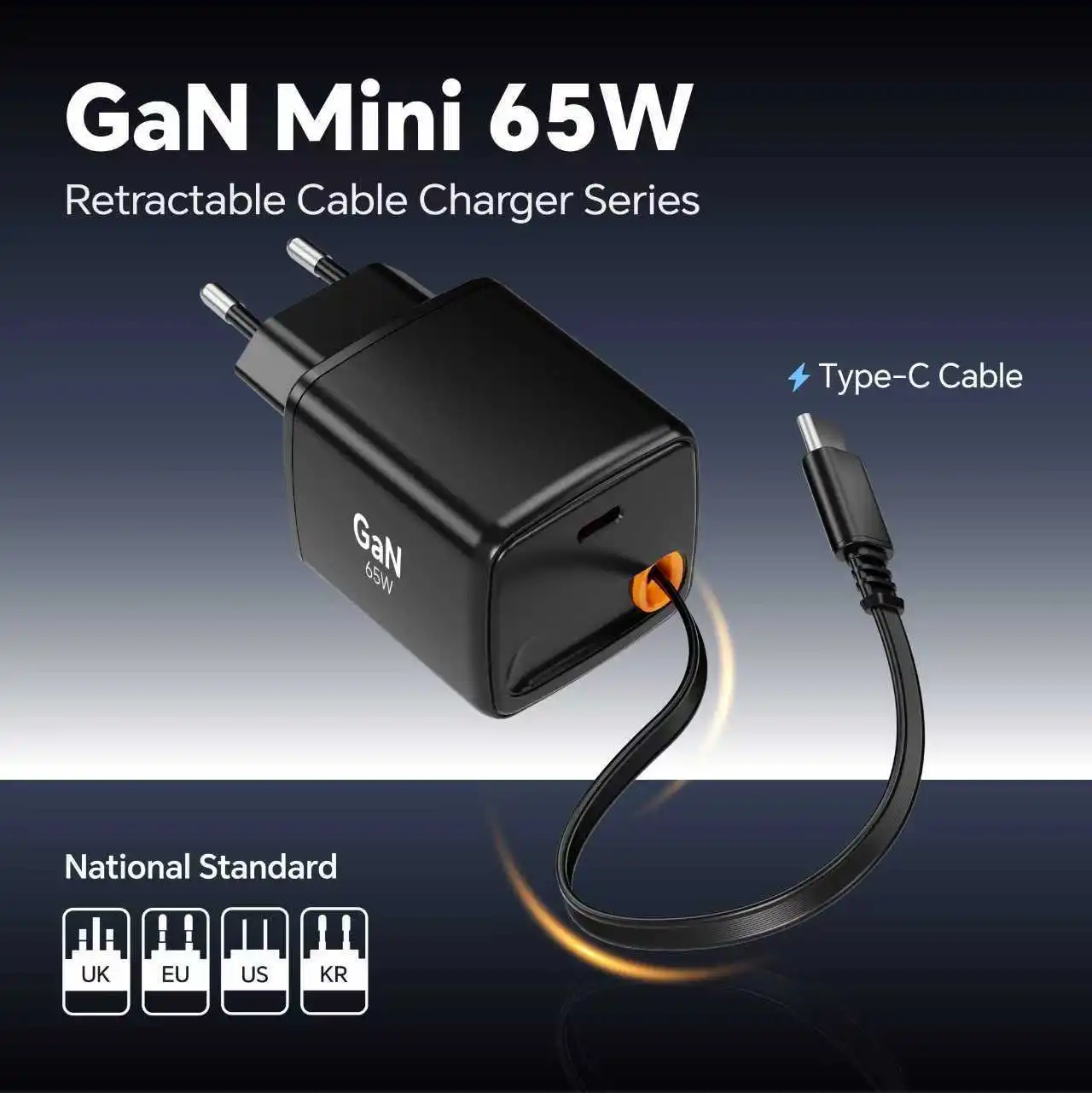
TRAVEL / COMPACT: 65W GaN Mini Retractable Cable Charger – Dual USB-C Port (C+C)
The travel-first form factor. This is the product we reach for when the brief is “user forgets to pack a cable.” The magnet snaps the connector flush, the housing fits in a shirt pocket, and the 80cm extension covers any standard overnight-stand charging setup.
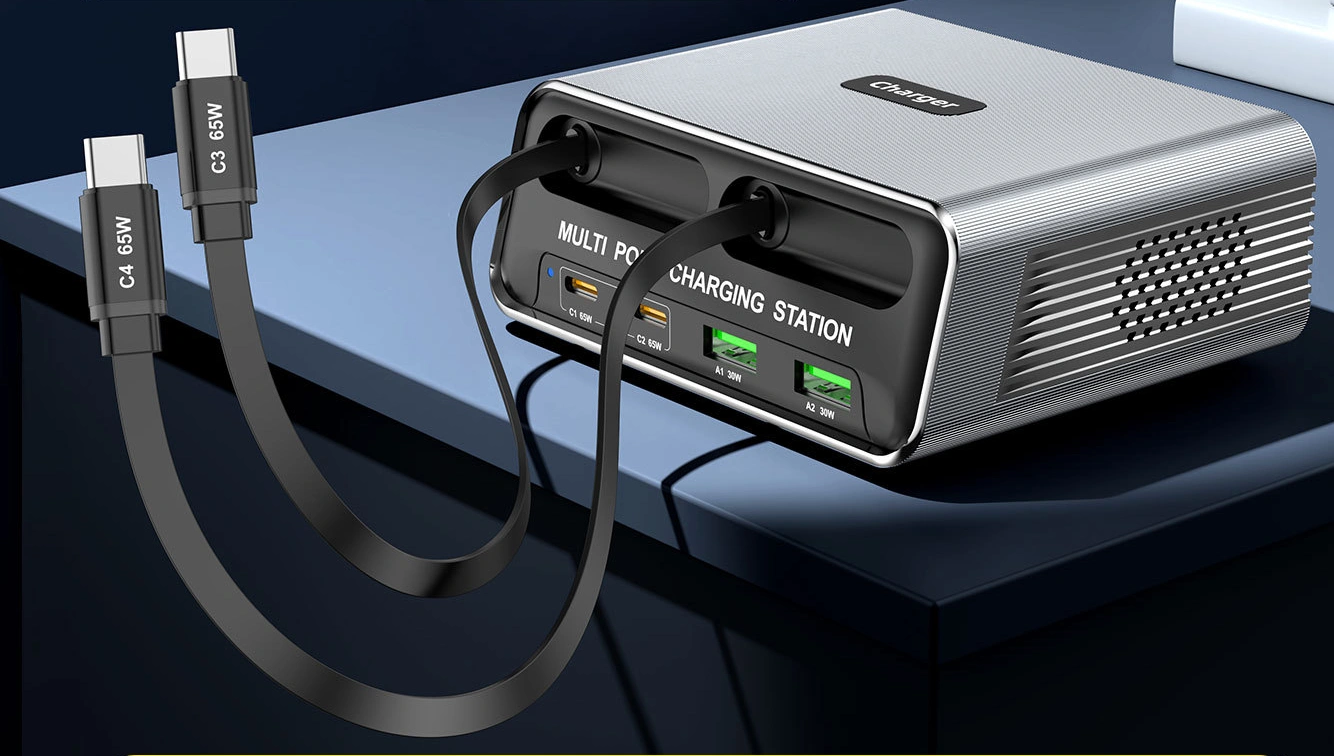
DESKTOP STATION: 100W GaN Dual Stretch Retractable Cables Desktop Charging Station
The cable-free desk solution. Two retractable USB-C cables (70cm each) emerge from the top of the station and are stored in parallel — eliminating the most common point of desktop cable chaos. With 100W GaN output, this station simultaneously powers two laptops plus four additional ports.
OEM Considerations: What to Specify When Ordering
For brands and distributors sourcing retractable GaN chargers for private-label production, the following specification decisions have the largest impact on product quality and customer satisfaction:
| Specification | Budget Tier | Quality Tier (Recommended) |
|---|---|---|
| Cable jacket material | Standard TPE | TPE-E / High-elasticity TPE |
| Conductor strand count | 7–12 strands per conductor | 30+ strands (fine-strand construction) |
| Magnet grade | N35 (no temp rating) | N52H (rated to 120°C) |
| Retraction cycle test | 3,000–5,000 cycles (room temp) | 10,000+ cycles incl. temp extremes |
| Strain relief length | 5–8mm | 12–15mm graduated hardness |
| EMI shielding at magnet | Not specified | Mu-metal foil around data conductors |
| Spool exit radius | Unspecified (may cause kinking) | Min. R5mm smooth ceramic-coated guide |
| Certifications | CE (self-declared) | CE + FCC + RoHS + USB-IF (PD compliance) |
We share this table openly because quality specification is genuinely in both parties’ interests. A product that fails at the 3,000-cycle mark will generate returns and damage your brand — and our reputation as the manufacturer. The incremental cost of the quality-tier specification above is typically $1.20–$2.50 per unit at volume, which is trivial relative to the cost of a product recall or a 3-star Amazon review wave.
Where Retractable GaN Charger Design Is Heading
Based on what we are seeing in product development pipelines and at industry exhibitions, these are the next meaningful design evolutions:
Higher Wattage Retractable Cables (100W+ per retractable port)
Current retractable cable designs typically cap the retractable ports at 33–65W, with the higher-wattage USB PD ports being the non-retractable ones. The constraint is conductor gauge — higher current requires thicker copper, which resists coiling. Engineering solutions under development include flat ribbon cable spools (which tolerate tighter bend radii) and silver-plated copper conductors (higher conductivity at the same cross-section, allowing thinner wire at equivalent current capacity).
USB4 / Thunderbolt Signal Integrity in Retractable Cables
Current retractable cables are predominantly USB 2.0 data speed (sufficient for charging but not for high-speed data or video). USB4 and Thunderbolt 4 have extremely tight requirements for cable impedance matching — requirements that are significantly harder to maintain in a coiled, high-dynamic-stress cable. The first retractable USB4-capable cables are expected in 2026–2027, but at significant cost premium.
Replaceable Cable Modules
A legitimate sustainability criticism of retractable chargers is that the permanently integrated cable cannot be replaced when it wears out, meaning the entire charger is discarded. Several manufacturers are now exploring modular cable cartridges — user-replaceable spool units that click into the charger base. This also opens commercial opportunities (selling replacement spools, upgraded cable modules for different wattages). We are actively prototyping a modular architecture and expect to offer it as an ODM option in late 2026.
Magnetic Positioning Lock (Adjustable Length)
The Baseus 2025 design introduced an 8-position magnetic lock, allowing the cable to be held at any of eight preset extension lengths without requiring the user to maintain tension. This is a significant UX improvement for desktop use cases where you want a specific cable length to reach a device on a particular surface. We anticipate this becoming a standard feature in the mid-range tier by 2026.
Frequently Asked Questions
How does the magnetic retraction mechanism work?
A small neodymium magnet (typically N52H grade, rated to 120°C) is embedded in the USB-C connector tip. When the cable is fully retracted, this magnet aligns with a matching magnet or ferromagnetic plate inside the charger housing, holding the connector flush against the body. To deploy, a gentle tug (overcoming approximately 0.5 N of magnetic force) extends the cable and unwinds the spring-loaded spool. To retract, a short inward tug releases the cable from friction hold and the spring reels it back, with the magnet snapping the connector home.
Why is nylon braid not used on retractable cables when it is used on premium standard cables?
Nylon braid has high surface friction and stiff fibres that cause the cable to bind on the retraction spool, preventing clean spooling. The braided fibres also catch on the cable exit port edge and fray rapidly. In a standard cable (not retractable), nylon braid is excellent because it adds tensile strength and abrasion resistance without needing to coil smoothly. For retractable applications, TPE-E is the correct material — low friction, no memory, flexible at all temperatures.
What is the maximum cable length for retractable GaN chargers, and why?
Most retractable GaN chargers offer 70–100cm maximum extension. The upper limit is set by the spool volume available inside the housing. Longer cables require a larger spool diameter or more coil wraps, both of which either increase housing size or tighten the cable’s bending radius (increasing stress per cycle). A 70–80cm cable is the engineering sweet spot that covers the vast majority of charging scenarios without requiring the charger to be unreasonably large.
Can retractable GaN chargers charge laptops?
Yes — provided the retractable port supports USB PD at sufficient wattage. Our 160W desktop station delivers 48W per retractable cable port (adequate for most MacBook Air, Dell XPS 13, and HP Spectre models) and 155W total across all ports. The 30W mini travel charger is suitable for lightweight USB-C laptops up to 30W (MacBook Air 13″ charges at ~30W on a single 30W port). For higher-wattage laptops (MacBook Pro 14″, ThinkPad X1), use the higher-power non-retractable USB-C ports on desktop station models.
How many retraction cycles should I expect before failure?
GaNCharge standard products are tested to 10,000 retraction cycles. At 3 retractions per day (typical business traveller), that represents approximately 9 years of daily use. Commercial-grade deployments (hotels, offices) should expect 8 retractions/day, giving roughly 3.5 years at 10,000 cycles. For commercial deployments, we recommend specifying 25,000-cycle cable assemblies and building a 3-year replacement cycle into your procurement planning.
Are retractable cable chargers safe for data transfer, not just charging?
Most current retractable cables are USB 2.0 speed (480 Mbps) and are optimised for charging, not high-speed data. The USB-IF specification for USB4/Thunderbolt has stringent impedance requirements that are difficult to maintain in a coiled cable. If you need both fast charging and USB4 data transfer from the same cable, a standard high-quality USB4 cable is currently the more reliable choice. USB4-capable retractable cables are in development and expected to enter the market at premium price points in 2026–2027.
What certifications should a quality retractable GaN charger carry?
At minimum: CE (EU), FCC Part 15 (US), RoHS (hazardous substances), and USB-IF certification for the USB PD protocol stack. For commercial deployments in North America, UL listing is additionally recommended. GaNCharge products carry CE, RoHS, and CCC as standard, with FCC and UL available for specific SKUs and OEM orders targeting North American markets.
Conclusion: The Engineering Behind the Click
The satisfying snap of a magnetic USB-C connector parking itself flush against a charger body is the result of a surprisingly deep engineering stack: a correctly-graded neodymium magnet, a TPE-E cable jacket that coils without memory, a spring-spool mechanism with the right retraction force, fine-strand copper conductors that tolerate thousands of bending cycles, and a GaN circuit squeezed around all of it while still managing heat effectively.
None of these decisions are glamorous. None appear on product box photography. But every one of them determines whether a user’s retractable charger still works flawlessly after two years of daily use — or whether it ends up in a drawer by month six, replaced by a tangled conventional cable.
At GaNCharge, this engineering is available to your brand through our OEM and ODM programmes — from adding your logo to our tested platforms to developing entirely custom retractable charger architectures. The starting point is a conversation about your requirements.
Related Reading on GaNCharge
- Retractable Cable GaN Chargers — Category Overview
- 160W Dual Retractable Cable Desktop Station — Product Page
- 30W GaN Mini Retractable Charger — Product Page
- GaN Charger OEM Manufacturing — Full Capabilities
- Why 140W+ PD 3.1 Is the New Standard for AI Laptops in 2026
- Top 5 Retractable Cable Charger OEM Manufacturers in Shenzhen, 2026