


Two chargers can look nearly identical, claim the same wattage on the box, and still sit far apart in price. The gap is almost never in the plastic shell — it’s in the components you never see, and the process that puts them together.
We get a version of the same question from buyers almost every week: two chargers look the same, they’re both labelled “65W” or “100W,” so why does one quote come in at roughly double the other?
It’s a fair question, and the honest answer is that the price difference is almost entirely hidden. It’s not in the shell, the box art, or the printed wattage — it’s inside the housing, in decisions about which grade of chip, capacitor, transformer, and MOSFET went into the design, and how carefully the production line verified that those parts actually made it into every unit.
This article walks through exactly what those internal differences are, why they matter beyond just “durability,” and what a buyer can reasonably ask a supplier to understand where a price actually comes from — rather than just comparing the number at the bottom of a quote.
The core idea in one sentence:
Don’t ask “why is this one cheaper” — ask “what did the cheaper one leave out to get there.” Sometimes the answer is an efficient factory with good yields. Often, it’s a component substitution you can’t see from outside the box.
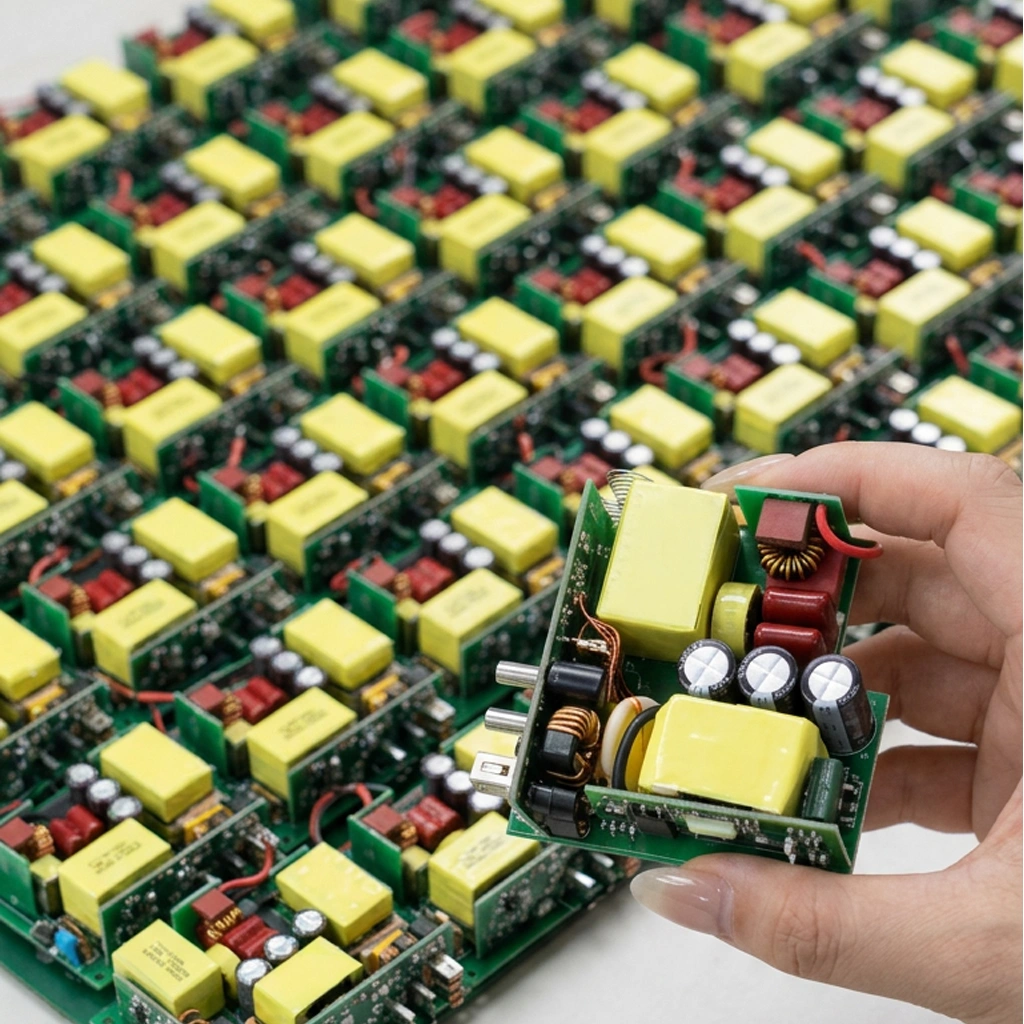
Table of Contents
What You Can See vs. What Actually Costs Money
A charger’s retail price is built almost entirely from things a customer cannot inspect before buying: the internal silicon, the passive components, the copper in the transformer, and the labour and testing time spent verifying the unit before it ships. The housing, the printed logo, and the box are a small fraction of total cost — and yet they’re the only part most comparisons actually look at.
WHAT’S USUALLY VISIBLE: Same on the Outside
Housing shape, size, and finish
Printed wattage and port count
Box design and included accessories
Certification logos printed on the label
WHAT ACTUALLY DRIVES COST: Different on the Inside
GaN chip brand, grade, and rated tolerance
Capacitor type, voltage rating, and lifespan hours
Transformer winding quality and copper gauge
MOSFET on-resistance and thermal rating
Burn-in testing time and final QC rigor
Component by Component: Where the Money Actually Goes
Open two chargers with the same printed spec, and you’ll typically find the same categories of parts — but not the same parts. Here is what to know about each:
GaN Power Chip
The core switching component. A branded, well-characterised GaN FET is tested across a wide voltage and temperature range with tight, published tolerances. A cheaper substitute may hit the same spec sheet number in a short bench test but drift further under sustained load.
Reference-quality suppliers include: GaN Systems, Navitas, Infineon, Transphorm — names that appear repeatedly in independent teardown analysis of premium chargers.
Capacitors
Filter and bulk capacitors set how cleanly the output voltage holds steady and how long the unit lasts before capacitor aging affects performance. Quality capacitors carry higher voltage headroom and longer rated operating hours at temperature.
Reference-quality suppliers include:Rubycon, CapXon, Vishay — commonly found supplying the primary and output-filtering stages in independently torn-down flagship chargers.
Transformer
Converts and isolates voltage between the mains side and the output side. Winding quality, copper gauge, and core material directly affect efficiency, heat, and — critically — the safety isolation between mains voltage and the device you’re charging.
Reference-quality suppliers include:Delta, Sumida — established transformer manufacturers frequently found in premium charger teardowns, often paired with copper-foil shielding for better heat dissipation.
MOSFETs
Handle output switching and protection functions. On-resistance (measured in milliohms) determines how much power is wasted as heat at the output stage — a lower-resistance MOSFET runs cooler and wastes less energy, which compounds across thousands of charge cycles.
What to check: Rated voltage headroom above the actual operating voltage, and on-resistance in the low single-digit milliohm range for premium designs.
Inductors & Resistors
Smaller in cost individually, but collectively responsible for output ripple, noise filtering, and protection-circuit accuracy. Cutting corners here rarely causes an obvious failure — it shows up as marginally worse output stability that most users never diagnose.
What to check: Whether the design uses discrete quality components throughout, or substitutes generic parts in the “invisible” sections of the circuit.
Protection & Sensing Circuit
The components that detect over-current, over-voltage, over-temperature, and short-circuit conditions and shut the charger down safely. This is the circuitry most likely to be quietly simplified in a cost-reduced design — because its absence is invisible until the day it’s needed.
What to check: Ask explicitly which protection functions are implemented (OCP/OVP/OTP/SCP) and whether they are validated in third-party safety testing, not just claimed on a spec sheet.
Why this doesn’t show up in a quick test
A cheap charger and a well-built one will often both power a phone just fine on the store counter. The difference between quality components and corner-cut substitutes rarely shows up in the first five minutes of use — it shows up over months, under sustained load, in hot environments, or during an edge-case fault condition. That’s exactly why component quality is so easy to under-price and so easy for a buyer to overlook.
Manufacturing Process & Quality Control
Component grade is only half the story. Two factories using identical bill-of-materials can still produce chargers with meaningfully different real-world reliability, depending on how disciplined the production and testing process is.
Where cost gets cut in the process, not just the parts list
- Incoming component inspection. A rigorous line verifies that received components actually match the specified part number and grade — not a cheaper “equivalent” substituted by a sub-supplier without notice. Skipping this check is invisible on a finished product but opens the door to silent downgrades over a production run.
- SMT assembly precision. Solder joint quality, component placement accuracy, and reflow temperature control affect long-term reliability in ways that don’t show up in day-one testing.
- Burn-in / aging testing. Running every unit under load for an extended period before packaging catches early-life component failures before they reach a customer. This step takes real production time and is one of the first things cut under cost pressure.
- Final electrical testing. 100% unit testing — output accuracy, protection circuit response, safety isolation — versus sample-based testing on only a percentage of units. The gap between these two approaches is invisible until a defective unit slips through.
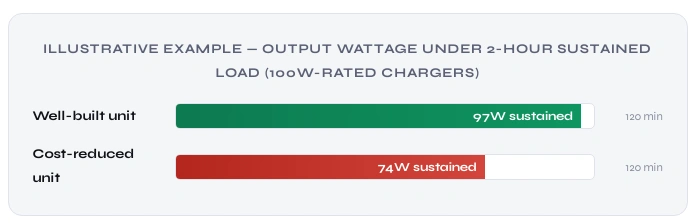
Illustrative pattern based on the type of thermal throttling commonly observed in independent charger testing when undersized components or inadequate cooling force a unit to reduce output to stay within safe temperature limits — both units may report the same wattage on the box.
“We tell customers the same thing every time this question comes up: don’t focus on who’s cheaper — focus on where the price difference actually went. A charger that costs less because a factory found genuine efficiency in its production line is a good find. A charger that costs less because it swapped a branded GaN chip for an unbranded equivalent, or skipped burn-in testing to save two days of production time, is a different product wearing the same spec sheet.”
GaNCharge Engineering Team
What the Difference Actually Feels Like
All of the component and process differences above eventually surface in three places a buyer or end-user does notice, even without opening the housing:
| Dimension | Corner-cut build | Quality build |
|---|---|---|
| Fit & feel | Lighter, hollow feel — thinner transformer, smaller capacitors | Solid, denser weight — proportional to genuine component mass |
| Sustained output | Drifts below rated wattage under continuous load as thermal protection engages | Holds rated wattage for hours without silent throttling |
| Heat under load | Runs noticeably hotter — higher-resistance components waste more energy as heat | Stays cooler — lower on-resistance parts and better thermal design |
| Long-term stability | Performance degrades over months as marginal components age | Consistent performance across the rated product lifespan |
| Failure mode | Less predictable — protection circuits may be simplified or absent | Fails safely — validated protection circuitry shuts down cleanly |
What to Actually Ask a Supplier
Since the real cost drivers are invisible from the outside, the most useful thing a buyer can do is ask questions that make them visible — before committing to a production order.
Questions worth asking before you compare quotes
- Which brand and model is the GaN power chip, and what is its rated tolerance range?
- What capacitor brand and voltage rating is used at the primary and output filtering stages?
- What is the transformer’s copper gauge and core material?
- Does the production line run 100% final electrical testing, or sample-based testing only?
- Is there a burn-in / aging test stage, and how long does each unit run under load before packaging?
- Which protection functions are implemented (OCP / OVP / OTP / SCP), and are they validated in third-party certification testing?
- Can the supplier share sustained-load test data — output wattage after 30, 60, and 120 minutes — rather than only a single-point spec sheet number?
A supplier confident in their build quality will answer these questions specifically and quickly. A vague or deflected answer to any of them is itself useful information — it tells you the price you’re being quoted may be built on the version of the story you can’t see.
The bottom line
A lower price is not inherently a red flag — genuine manufacturing efficiency, scale, and process discipline can legitimately produce a lower quote without cutting anything that matters. The problem is only when the savings come from component and testing shortcuts that show up later, as returns, safety incidents, or damaged brand trust — costs that almost always outweigh what was saved per unit.
HOW GANCHARGE APPROACHES THIS
Component-Level Transparency for OEM Partners
We share the actual bill-of-materials grade for chips, capacitors, and transformers with OEM partners during the quoting process — not just a spec sheet with a final wattage number. Every production run includes 100% final electrical testing and a burn-in stage before packaging. If you’re comparing quotes for a private-label GaN charger project, we’re happy to walk through exactly what’s inside ours, component by component, so you can compare on equal terms.
Frequently Asked Questions
Why do two GaN chargers with the same wattage and appearance cost differently?
The price difference is almost entirely hidden inside the housing. Two chargers can share the same printed wattage and a near-identical shell while using very different grades of internal components: the GaN power chip, capacitors, MOSFETs, transformer, and inductors. A cheaper unit typically uses lower-grade or unbranded versions of these components, thinner copper in the transformer winding, and a less rigorous production and testing process — none of which is visible from the outside.
Does a more expensive GaN chip actually make a difference in real-world use?
Yes, in three measurable ways: efficiency (how much input power is wasted as heat versus delivered to the device), sustained output stability under continuous load, and long-term reliability. A branded GaN FET from an established supplier is characterised and tested across a wide temperature and voltage range with tight tolerances. A lower-cost alternative may test fine on a bench for five minutes but drift or degrade faster under sustained real-world use.
Can you tell the quality of a charger’s internal components without opening it?
Not directly, but there are reliable proxies. Weight is one — quality transformers and capacitors add real mass, so an unusually light charger at a given wattage often signals thinner windings or smaller capacitors. Sustained-load behaviour is another — a well-built charger maintains rated wattage for hours, while a corner-cut unit often shows measurable power decay after 20–30 minutes. Certification (CE/FCC/UL) is a third proxy, since these tests indirectly validate component quality.
Should I always choose the cheapest charger with the specification I need?
Not without understanding where the savings come from. A lower price isn’t inherently a problem — it becomes one when it’s achieved by cutting components or testing steps that affect safety, sustained performance, and lifespan. The more useful question is not “which is cheaper” but “what did the cheaper option leave out to get there.” For OEM buyers, the cost of a field failure or return wave is almost always larger than the per-unit savings that caused it.
What quality control steps should a GaN charger go through before shipping?
A rigorous line includes incoming component inspection (verifying received parts match the specified grade), in-process testing during SMT assembly, a burn-in or aging test running each unit under load for an extended period, and 100% final electrical testing before packaging — checking output accuracy, protection circuit response, and safety isolation. Skipping or shortening any of these stages is one of the most common ways cost gets reduced, and one of the least visible in a finished product.
Related Reading
- GaN Charger OEM Manufacturer — Full Capabilities & Process
- Multi-Port High-Wattage GaN Chargers — Category Overview
- Retractable Cable GaN Charger: Design, Materials & Magnetic Mechanism Explained
- 2026 Top 7 High-Wattage Fast Charging Manufacturers in Shenzhen
Send us the specification you’re evaluating and we’ll walk you through a transparent, component-level breakdown of what a fair quote should include.